
Direct answer
For your first battles, fill the castle with Peasant Huts and upgrade them whenever the price is affordable. Gold is earned during the battle and spent on buildings that keep sending troops; Souls arrive between levels and buy permanent unlocks. Keep the wall above zero, let the production cycle do the fighting, and do not rush every new unit before the opening loop is stable.
What the first run actually asks
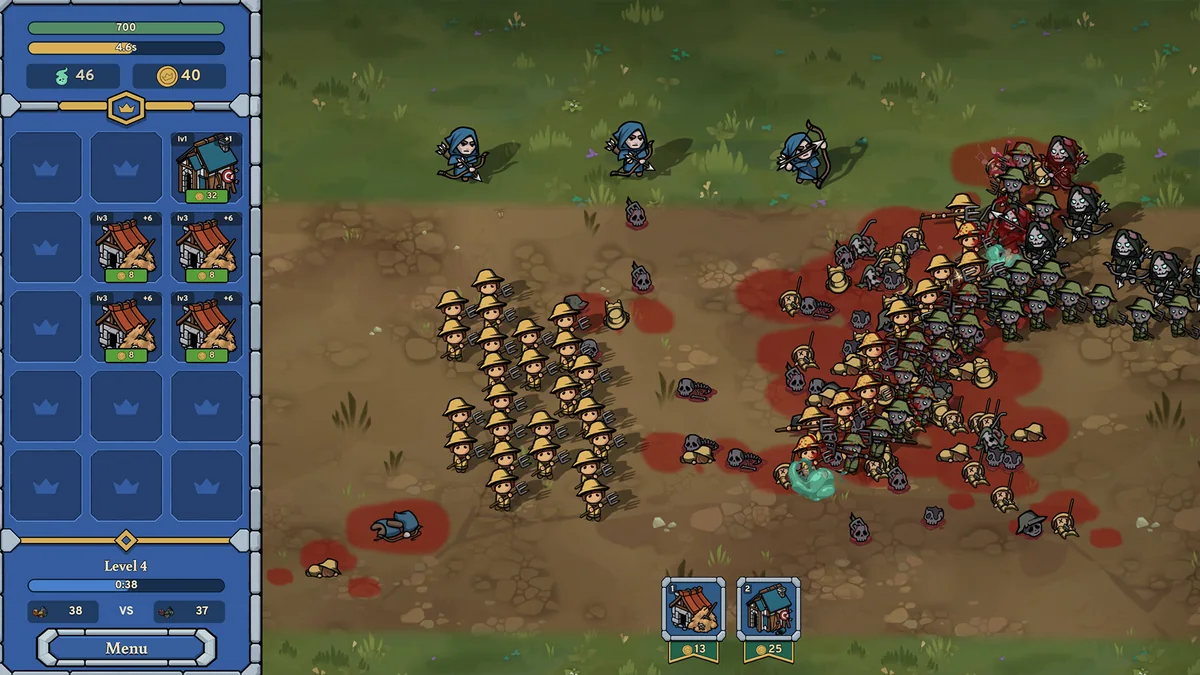
You are defending a castle against Moriana, and every battle is automated once it starts. Your job is not to aim troops. It is to decide what the castle produces and when to pay for the next level of it. The Steam listing describes the loop plainly: earn Gold by killing undead, spend it on buildings that send more soldiers, then use Souls between levels for units and improvements.
- The castle has 15 building slots in a 3-column by 5-row grid, as shown in the interface and described in community guides.
- Seven building types are placed with the number keys 1–7 once unlocked: Hut, Range, Barracks, Tower, Stable, Chapel and Arcane Sanctum.
- The top-left wall meter is your health. The yellow meter under it is the production cycle; when it fills, every building prints its units.
- If enemies break the wall, the battle is lost. There is no partial credit for a large army.
This guide covers the first battle through the first meaningful between-battle purchase. It does not replace the campaign walkthrough or the stage builds. Current build checked: 1.2.3.
Your first battle: build, upgrade, repeat
Open with cheap production, not variety. A Hut prints Peasants. Peasants are weak individually, but they are the cheapest way to keep bodies between the enemy and the wall, and one creator notes that a dying Peasant leaves Gold behind. That makes a hut-heavy opening both a shield and a small income stream.
- Place Huts in the slots you can afford. Early on, a partly filled grid beats waiting for a perfect layout.
- Click the green price tag on each building whenever you can. Upgrading a production building is usually worth more than adding another level-one building at the same cost.
- Watch the yellow cycle bar, not the battle animations. The bar tells you when the next batch arrives; if production is too slow, the wall number will fall before the next batch lands.
- Use pause while you learn. With Enable Pause turned on in Gameplay Settings, T pauses the battle and still allows building and upgrading. Since 1.2.0, Space is always available as a pause key.
- Keep a reserve for the next upgrade. Spending to zero on a new building can leave you unable to upgrade the production you already have.
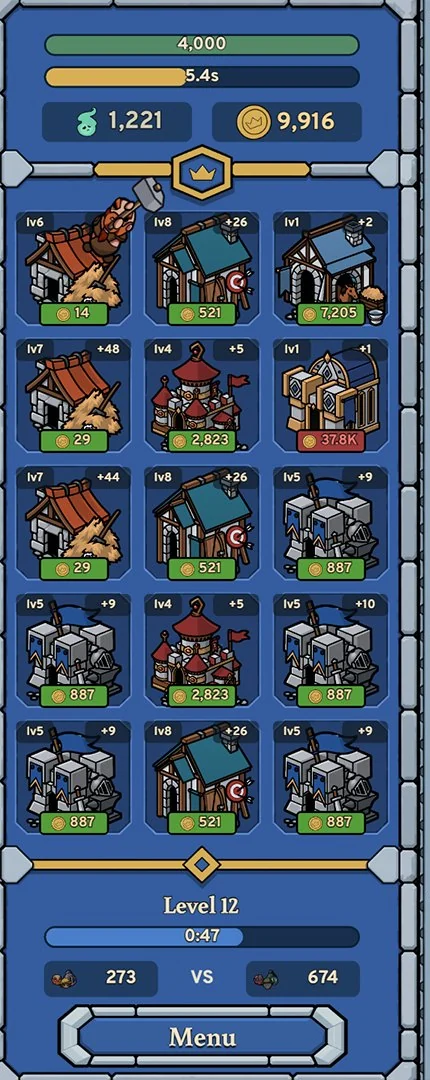
The first wave is forgiving enough that a hut line plus steady upgrades should hold. If it does not, the usual cause is not a missing unit type. It is unspent Gold sitting while the wall takes damage.
Gold and Souls do different jobs
The two currencies are not interchangeable, and treating them as one wallet is the most common early mistake. Gold exists inside a battle. Souls exist between battles. A building bought with Gold disappears when the battle ends; a talent or unit unlocked with Souls stays.
| Gold | Souls | |
|---|---|---|
| Earned | Killing undead during a battle; Peasant deaths when Disposable Income is owned | From defeated foes, credited around the between-level screen |
| Spent | Buildings and building upgrades inside the current battle | Units, reserves, castle upgrades and talents between levels |
| Persists | No — reset with the battle | Yes — unlocks remain across levels until a Prestige restart |
| Best first use | More Huts, then upgrades on your main production | The first unit unlock or a cheap economy talent |
Swipe the table horizontally to see every column.
The official store and site both describe this split without promising exact income. There is no official Gold-per-kill or Souls-per-level table, so a guide that quotes a fixed early income is describing one run, not a rule.
Your first between-battle purchase
Buy the unlock that removes a problem you can already see. If your front line evaporates before the wall, Archers add damage from behind it. If your income stalls, economy talents compound. If you keep losing to the same wave shape, a new unit type will not fix a production problem.
- Archers are the usual first combat unlock and the achievement list confirms they are bought in the talent tree. Put a Range behind the melee line; a creator reports an extra Archer when a melee building sits to its right.
- Knights are a later unlock, but they also bring Construction Workers, which can upgrade buildings automatically. That is a change in how the run is played, not just a new body.
- Economy talents such as Gold Gain and Disposable Income pay back across every following level. Disposable Income also feeds the Death and Taxes achievement at 100,000 Gold earned.
- Castle slots are worth taking when your grid is full. The slots are unlocked through the talent tree rather than one by one.
A community achievement guide recommends a rough order of Gold Gain and Disposable Income, then Construction Worker price and speed, then castle slots, then wall units, then Paladins and Archmages. That order assumes you are pushing toward 100%, so treat it as a sensible default rather than a requirement. If a level keeps failing, buy for that level.
What to check after an early loss
There is no official failure screen that explains the cause. Use the interface in this order, because each check is cheaper than the next.
- Wall health at the moment of collapse. If it fell quickly after a long stable period, the issue is late-battle damage, not the opening.
- Empty slots. Gold in the bank and an empty grid is unspent production.
- Unclicked upgrade tags. A grid of level-one buildings produces far less than a smaller grid of upgraded ones.
- Placement. Huts gain from being connected to other Huts; an Archer Range gains from a melee building on its right. A layout copied without its neighbours can underperform.
- Gold at the end. A large unspent balance means you were saving for the wrong purchase or forgot the cycle timing.
- Enemy composition. Enemy casters that wipe clumps need spread production or a Tornado, not another Hut.
If all six look healthy and the wall still falls, the level is asking for a different unit or a talent you have not bought yet. That is the point to visit the stage builds rather than replay the same layout harder.
When to unlock the rest of the roster
Unlock a new unit when its job is missing, not because the Souls are burning a hole in the menu. The first twenty levels can be cleared with Peasants, Archers and steady upgrades; the later levels are where Paladins and Archmages start to matter. The achievement guide’s own progression advice waits until the campaign is complete before doing the layout achievements, because every stage can be replayed.
One warning from the community: a hut-only run tends to hit a soft cap around Level 25, where enemy Archmages out-range the swarm. An archer-only run can reach the final boss but turns into a standoff. Those are observations from players on the current build, not official balance statements, but they explain why the roster eventually matters.
Changes that affect this advice
- 1.1.0 added active pause on T, new unit talents, and new enemy waves on levels 12–30.
- 1.2.0 made pause always available on Space, moved Time Warp to the Prestige layer, and enlarged the battlefields.
- 1.2.1 cut Mage and Archmage health and damage and made low-tier reinforcements cheaper, so early Peasant and Archer play got relatively better.
- 1.2.2 lowered several talent costs and clarified that Upgrade All follows manual upgrades.
- 1.2.3 shortened later levels and fixed the 2 GB graphics-card startup crash.
A video or guide recorded before 21 November 2026 may still show Time Warp in the normal talent tree or describe battles that speed up automatically. Both are out of date.
Questions players ask
Can I pause the battle?
Yes. Since 1.2.0, Space always pauses. If you want to place and upgrade buildings while paused, turn on Enable Pause in Gameplay Settings and use T (default) as well.
Do Peasants really give Gold when they die?
A creator’s launch-build footage shows Peasants dropping the Gold they carried. The Disposable Income talent formalises this as passive income, and the Prestige talent Blood Money raises it from 1 Gold to 5 Gold per Peasant death.
How many building slots does the castle have?
Fifteen, arranged as 3 columns by 5 rows. You unlock the seven building types in the talent tree rather than unlocking slots one at a time.
Does demo progress carry into the full game?
The demo is a separate Steam app and the checked official sources do not document save transfer. One creator reported at launch that their demo progress did not import. Treat a carry-over as unconfirmed rather than promised.
Should I restart when a level goes badly?
Restart when the wall is falling and your Gold cannot change the outcome. A loss does not erase Souls or unlocks, so a quick restart is cheaper than watching a doomed battle finish.
Sources and scope
This page was written from public sources checked on 25 November 2026. No hands-on play is claimed. Patch behaviour can change; the build noted at the top is the scope of these notes.
- Steam store pageLoop, currencies and 30-level structure
- Polished Games game pageSouls and unit roster
- Update 1.1.0 notesActive pause, unit talents, later waves
- Update 1.2.0 notesSpace pause, Prestige, Time Warp move
- Hotfix 1.2.3 notesLater-level length and 2 GB crash fix
- Steam achievement directory41 official entries
- Splattercatgaming gameplayCreator footage used for hut placement, adjacency and Peasant Gold