
Direct answer
Gold comes from killing undead during a battle, and it is spent only inside that battle on buildings and upgrades. Keep the cheapest production filled first, then upgrade the buildings that already carry your line. The mistake that ends runs is not a low income — it is Gold sitting in the bank while empty slots and unclicked upgrade tags do nothing.
Where Gold comes from
The store describes the loop in one sentence: earn Gold by slaying undead enemies and spend it on buildings that send more soldiers. That is the primary source in every version. Two secondary sources sit on top of it.
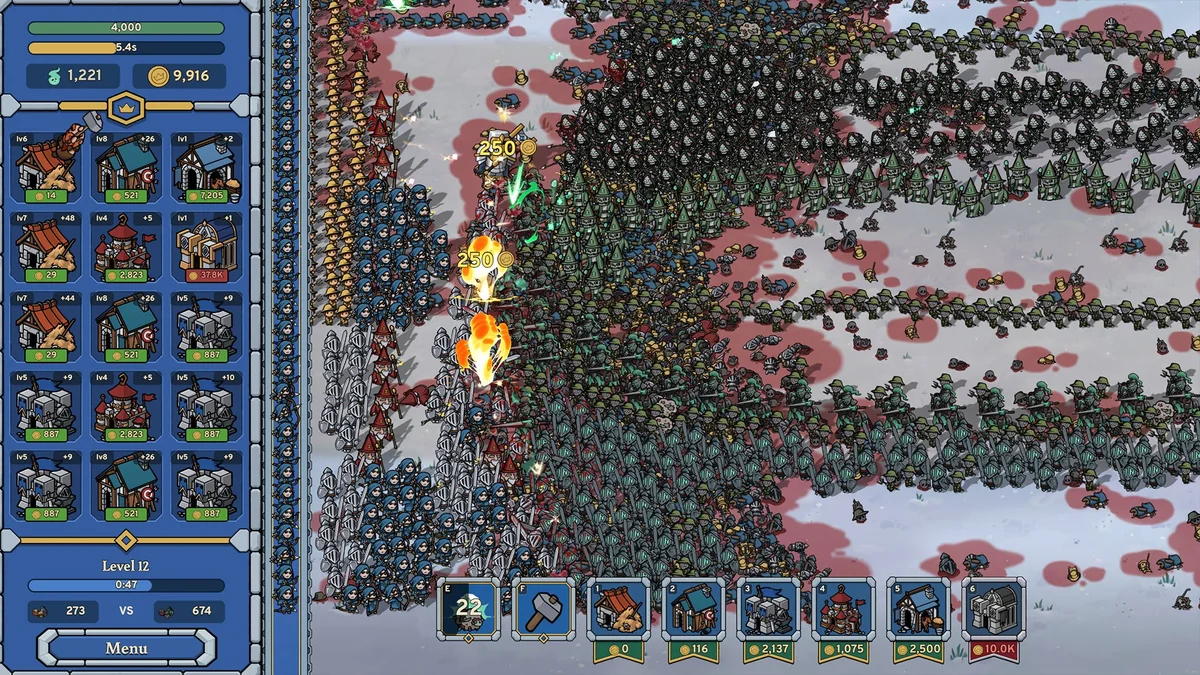
- Peasant deaths. A creator’s launch-build footage shows Peasants dropping the Gold they carried. The Disposable Income talent turns this into a passive income line.
- Disposable Income. The talent pays Gold per Peasant death. The Prestige talent Blood Money raises that from 1 Gold to 5 Gold per death and is active from the start of a run.
There is no official Gold-per-kill or Gold-per-level table. The amount you see depends on the level, the enemy mix and your talents, so a fixed number from another player’s run is not a benchmark.
The spending order that keeps production growing
Treat each purchase as a choice between more bodies now and more bodies per cycle later. The second is almost always better once the first row is filled.
- Fill cheap slots while the wave is small. An empty slot produces nothing; a level-one Hut at least adds Peasants to the wall.
- Upgrade the buildings that are already producing. The green tag on a building raises its level. A single high-level Hut usually beats two low-level ones for the same Gold.
- Buy the adjacency partner, not a random new type. Huts gain from connected Huts, and a Range gains from a melee building on its right. A new building that breaks those links is worth less than its price.
- Keep a small reserve for the next cycle. If the wall is falling, Gold you cannot spend before the next batch lands is wasted.
If you have Gold and an affordable upgrade tag, buy the upgrade. Add a new building type only when the wave needs a job your current line cannot do.
Adjacency makes the same Gold worth more
Placement is the multiplier on every Gold you spend. A Hut connected to other Huts produces extra Peasants, and an Archer Range with a melee building to its right prints an extra Archer. Those are the two rules a creator demonstrates directly; the achievement list confirms several more adjacency patterns without publishing percentages. The full grid is on Buildings and Castle Layout.
| Pattern | Effect | Evidence |
|---|---|---|
| Connected Huts | Each connected Hut adds Peasants to the others | Creator gameplay |
| Range with melee on its right | Extra Archer per qualifying Range | Creator gameplay |
| 10 non-Hut buildings next to a Hut | Love Thy Neighbor achievement, requires Be My Neighbor | Official achievement |
| Tower with four different neighbours | Higher Education, requires Well-Rounded | Official achievement |
| Stable with Huts on all four sides | Stable Relationship, requires Be My Squire | Official achievement |
Swipe the table horizontally to see every column.
Because the percentage bonuses are not published, judge a layout by the production number shown on each building after you place it. If the number does not rise when you expect a bonus, the pattern is not active.
Why costs explode late in a run
Upgrade prices climb steeply as building levels rise. In a late-campaign recording, a single upgrade is shown at roughly 650 million Gold by the final battle. The A King’s Ransom achievement only asks for one purchase of 1,000,000 Gold or more, which shows how far the scale moves between the opening and the end.
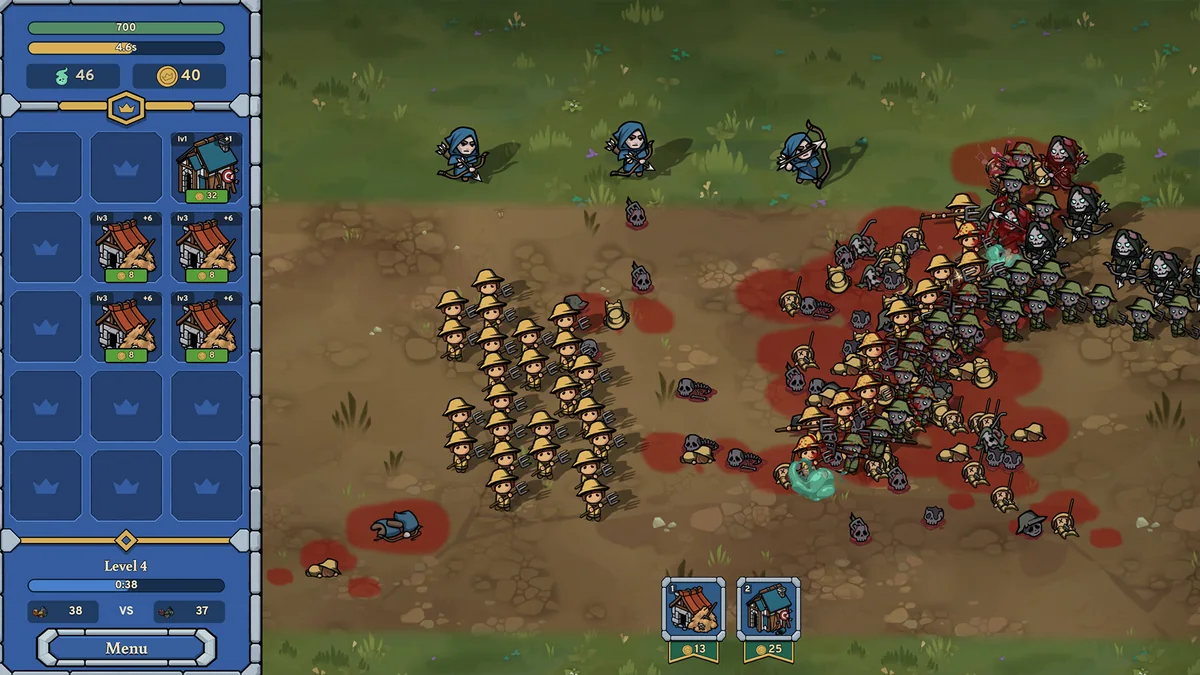
That is also why the Construction Worker price limit matters. Since 1.2.0, the three price-limit talents add 100, 5,000 and 100,000 Gold per rank, and the full-rank limit is 720,450 Gold instead of the old 37,250. Once a building’s next level costs more than that, the workers stop and you must upgrade manually — or let Inspiration push one upgrade past the cap. The Above Your Pay Grade achievement is tied to exactly that event.
- A single building upgrade at 1,000,000+ Gold is the A King’s Ransom condition.
- The worker price cap is a hard stop for automatic upgrades, not a soft suggestion.
- Inspiration can exceed the cap and is the documented way to keep a single building climbing.
When to stop spending
Stop buying when the next purchase cannot arrive before the wave that will decide the battle. That usually means the last thirty seconds of a losing level: a new building placed then produces one weak batch, while the Gold could have gone into a level on your main line earlier.
The other case is deliberate saving for a specific upgrade. If the next level of your main production is close and clearly better than two small purchases, hold the Gold and click it as soon as it is affordable. Do not hold Gold without a named target.
What changed in 1.2.x
- 1.2.0 added Blood Money at 5 Gold per Peasant death, raised the worker price-limit talents and changed several talent costs.
- 1.2.1 made low-tier reinforcements much cheaper and cut Mage and Archmage stats, shifting value toward Cheap units and Archers.
- 1.2.2 cut Pitchfork, Peasant, Archer and Knight Reserve costs again.
- 1.2.3 shortened later levels by changing time scaling from 6 to 4 seconds, so Gold per real minute on late levels is higher than an older recording suggests.
Questions players ask
Does Gold carry between levels?
No. Gold is the in-battle currency: it is earned and spent inside the current battle. Souls are the between-level currency.
Do Peasants drop Gold when they die?
A creator’s footage shows them dropping the Gold they carried. Disposable Income formalises this as passive income, and Blood Money raises it to 5 Gold per Peasant death.
Why did my Construction Workers stop upgrading?
They stop when the next upgrade exceeds their price limit. At full price-limit talents in 1.2.0 and later that limit is 720,450 Gold, up from 37,250.
How do I unlock A King’s Ransom?
Pay 1,000,000 Gold or more for one building or upgrade. Late-stage upgrades reach that scale naturally.
Sources and scope
This page was written from public sources checked on 25 November 2026. No hands-on play is claimed. Patch behaviour can change; the build noted at the top is the scope of these notes.
- Steam store pageGold earned from kills, spent on buildings
- Update 1.2.0 notesBlood Money and worker price limits
- Hotfix 1.2.2 notesReserve cost changes
- Steam achievement directoryDeath and Taxes, A King’s Ransom, Above Your Pay Grade
- Splattercatgaming gameplayPeasant Gold, adjacency and upgrade tags
- Level 30 gameplay videoLate-game upgrade prices